
The Hammersteins – A Musical Theatre Family (Review)
Family biography can provide important insights and perspectives that are missing from other genres of historical writing. History teaches us that special knowledge is sometimes learned in families and passed on to new generations, including the transmission and nurturing of talents and the development of distinctive skills and abilities. This phenomenon can be observed in the family biographies of many of the great American business, banking, political and theatrical dynasties: the Astors, Morgans, Roosevelts and Schuberts, for example. In The Hammersteins – A Musical Theatre Family, the author vividly describes this phenomenon to explain the unprecedented rise of one the most talented and successful families in the history of world entertainment, a family which has justly earned the epithet of Broadway royalty. The author is Oscar Andrew Hammerstein, a fifth generation member of the dynasty founded by the extraordinarily talented impresario Oscar Hammerstein I who arrived in New York in 1864, aged just sixteen.
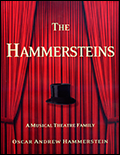 In the first part of The Hammersteins the author offers an engaging portrayal of the unfettered, entrepreneurial world of opportunity that was New York in the second half of the nineteenth century; a place where astute, canny individuals could win and lose great fortunes, only to win and lose them again. Oscar Hammerstein I personified this kind of boom and bust experience which, in his case, was based firmly on a rare combination of talents, frequent good judgment and massive self-confidence, driven by a combination of powerful personal convictions, courage, a degree of recklessness, a strong imagination and reservoirs of tenacity. He was in every way a larger-than-life character whose tendency to bombast was greatly outweighed by the astonishing depth, breadth and scale of his achievements. These ranged from building theatres and producing plays, musicals and operas, to writing words and music for several musical plays and operas including The Koh-i-noor Diamond (1893), Santa Maria (1896) and Marguerite (1986).
Hammerstein’s preoccupations and his progress in the theatrical world are neatly summarized in well-chosen chapter headings: ‘The Father of Times Square’; ‘Theatrical Phoenix’; ‘Opera War’ and ‘Oscar In Flames’. The author explains the pivotal role which Oscar Hammerstein I played in building Broadway theatre, promoting opera in America and in the creation of the Broadway musical by providing important opportunities to Victor Herbert and Lew Fields for example, who along with many others went on to be part of the bedrock upon which the musical itself was built. The esteem in which Hammerstein was held is witnessed in the response to his bankruptcy in 1897. To help restore Hammerstein to financial health, the managers and producers of Broadway rapidly assembled to host a benefit at the Garden Theatre: ‘the night’s tally was $25,000’ – a gift to Hammerstein. The author’s inclusion of this telling episode invites the question: would any Broadway producer in similar circumstances receive such assistance today?
Oscar Hammerstein I was a man who frequently excited passions and sometimes hostility in others, but he knew how to persuade even the toughest of individuals. The best example of this can be found (pp. 70-71) in the anecdote of ‘Melba and Hammerstein’ – one of several Australian threads that are woven into the Hammerstein dynastic story. The impresario was determined to persuade the great diva to sing in the first season at his grand, new Manhattan Opera House. Having pursued her all the way to Paris, Hammerstein, after several prior refusals, flung a wad of notes at Melba’s feet and ‘walked out in a shower of money’. Melba agreed to sing and Hammerstein made another fortune.
The Hammersteins reveals, in more detail than has been published previously, the stories of many other members of the large Hammerstein family, particularly in the stories of the four-times married Arthur Hammerstein and his daughter, the beautiful Elaine Hammerstein, who became a silent movie star in Hollywood. A notable feature of the developing dynasty was the tendency for Hammerstein men to marry more than once, usually producing more children. The author, without either labouring the point or resorting to unnecessary details, clearly explains some of the emotional difficulties that led to the breakdown of a marriage, or its termination due to death, and conveys a sense of the consequences, which were sometimes tragic, for new generations of the family. A poignant example of this (p.84) is how the author describes the death of thirty-two year old Alice, the wife of William Hammerstein, as a result of a botched abortion, making her fifteen-year old son, the future lyricist Oscar Hammerstein II, part of ‘a third generation of motherless sons’ in the Hammerstein family.
Oscar Hammerstein II is the focus of chapters seven to seventeen of The Hammersteins. Today, he is a much more familiar figure than his grandfather. Oscar Hammerstein II had the privilege of growing up in an extraordinarily creative family, strongly aware of his grandfather’s achievements and of the family’s position in the world of theatre. While Hugh Fordin’s excellent Getting To Know Him (Ungar, New York, 1977) as well as several other books, have already covered many aspects of his life and career, Oscar Arthur Hammerstein’s recent family history provides some new perspectives on it, enhanced by many lavish illustrations from the family archives. Musical theatre has no greater lyricist than Oscar Hammerstein II. The Hammersteins confirms that his is surely the most important career in the development of the book musical as an art form. It is unique and unsurpassable for at least three reasons: first Showboat, secondly Oklahoma (as a singular achievement) and thirdly the group of five ‘great’ Rodgers and Hammerstein musicals - Oklahoma, Carousel, South Pacific, The King and I and The Sound of Music. The group of five is the reason why in 2000 Andrew Lloyd Webber nominated Rodgers and Hammerstein for Time magazine as the two greatest collaborators in the history of the musical to date. As the author explains, Showboat was the first great book musical, one that remains relevant today because of the boldness and quality of Hammerstein’s writing and the timeless, magnificent melodies of Jerome Kern. Hammerstein’s work with Richard Rodgers, another member of Broadway’s royal family, on Oklahoma created the next stage in the development of the fully integrated book musical, realized in its most perfect form to that time. The four other ‘great Rodgers and Hammerstein musicals all added to or continued the form with their elegant combinations of social comment, sharply defined characterizations, superbly constructed books and some of the most memorable and touching music and lyrics ever created. In addition, as the author reminds us, Hammerstein broke new ground with his original works, Carmen Jones and Allegro, while achieving some golden results in his other work: winning the Academy Award twice for Best Song (‘The Last Time I Saw Paris’, 1941 and ‘It Might As Well Be Spring’, 1945) and with songs from Pipe Dream (1953) and Me and Juliet (1955) and especially from Cinderella (1957) and Flower Drum Song (1958)
The author does not resile from discussing some of the more intimate details of Hammerstein’s personal life, such as his difficult first marriage to Myra Finn, a distant cousin of Richard Rodgers. He recounts the change in Hammerstein’s life when he met the beautiful Australian Dorothy Blanchard in 1926. His meeting with her initiated the period of greatest achievements in Hammerstein’s career, beginning with Showboat the following year. When Dorothy became Mrs Oscar Hammerstein II, he settled down to, what seems to have been, a blissful marriage and an extraordinarily creative life, spent as much as possible on the Hammerstein farm in Bucks County, Pennsylvania. It was there that, as the author movingly recounts, Oscar Hammerstein II, having refused any further treatment for cancer, died on August 23, 1960.
The riches to be found in Oscar Arthur Hammerstein’s invaluable family biography cannot be conveyed briefly. Anyone who is interested in musical theatre and in the lives of those who created it must read this book. The Hammersteins is a treasure trove of musical theatre riches and an important addition to Broadway history and to the genre of family biography.
The Hammersteins – A Musical Theatre Family
By Oscar Arthur Hammerstein
Leventhal Publishers, New York, 2010
Review by:
Peter Wyllie Johnston
 2008-2026 © Melba Recordings